BN Life
On the Mother Road: Trees Through Time
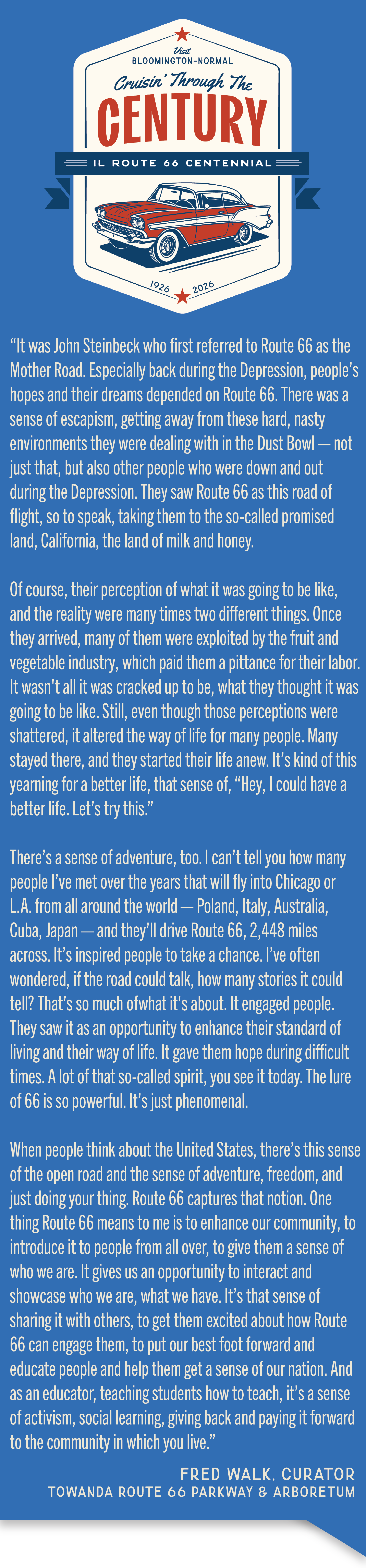
As we celebrate the Route 66 Centennial in 2026, we’re highlighting the places and people that make McLean County an essential stop along America’s Mother Road. Throughout the year, this 12-part blog series will spotlight iconic Route 66 locations and feature conversations with the mayors of our Route 66 communities, each sharing their own stories, history, and vision for the future. This installment marks 7 of 12 posts in the series, starting a journey that honors our past while inviting visitors to experience what makes our stretch of Route 66 unforgettable. Buckle up – there’s a lot of road left to explore!
Towanda Route 66 Parkway & Arboretum
The rise of the Interstate Highway System spelled the end for Route 66. As cross-country travel was sterilized in the name of efficiency, replacing the romance and charm of the Great American Road Trip, the Mother Road was left behind. In communities like Towanda, stretches of Route 66 were barricaded and forgotten, never again to carry travelers from one end of the country to the other.
But where some saw a painful memory of what the community had lost, Fred Walk saw something that could carry the legacy of Route 66 into the future. The Towanda native and longtime educator — first at Normal Community High School and then at Illinois State University —frequently drove past the intersection where the original two-lane highway had been closed, left to deteriorate. What began as a clever teaching tool has grown over the course of a quarter-century into the Towanda Route 66 Parkway & Arboretum — perhaps the only accredited arboretum on Historic Route 66.
“I thought, ‘Something could be done. I could use it to engage my students in the teaching of history,’” Walk said. “This was in 1999. I taught a U.S. history class at NCHS and one of the things I had my students do was read John Steinbeck’s book The Grapes of Wrath, which talks about using Route 66 as a road of flight to go out from the Dust Bowl and take the road west to California. I saw this as an opportunity to use the old road as an avenue to learn U.S. history and the impact Route 66 had on human migration patterns and the economic development of the nation.”
The assignment led to what Walk described as “a transformation.” While his students researched the former highway, talking to the former owners of gas stations and truck stops along the McLean County portion of Route 66, they uncovered a remarkable history. In time, the class created plaques and markers dedicated to the businesses that once lined the Mother Road.
But the markers weren’t the only transformation this stretch of pavement saw. Beginning with a single white oak tree planted in 1999, Walk and other volunteers have added a blooming grove of trees — 337 trees in total, representing 91 species. Some — like the white oaks, maples, oaks, hickories, and dogwoods — are native to Illinois, though the now-Level I accredited arboretum features a collection of American Heritage Trees representing unique, historic locations around the country. A sycamore grown from seeds derived from George Washington’s Mt. Vernon home. A sweet gum tree sprouted onboard the 1984 space shuttle Discovery mission. Swamp white oaks grown from acorns collected around the site of the World Trade Center. These trees embody not just the history of Route 66 or the state of Illinois — they’re representative of the country.
“It's special to think that you can see this tree and think, ‘My goodness, this tree was up in space, essentially. This tree was in front of Mt. Vernon.’ It really helps to further a connection,” Walk said. “That’s so much what history is about — making connections. It gives people a sense of admiration, seeing trees that are over 200 years old, and it gives them a sense of identity, I think, too, which helps them make these connections. The arboretum helps further their interest in history and helps them want to learn more. That's a big aspect of what I’ve been trying to do.”
Experience More Route 66 Nostalgia in our 2026 Visitor Guide